
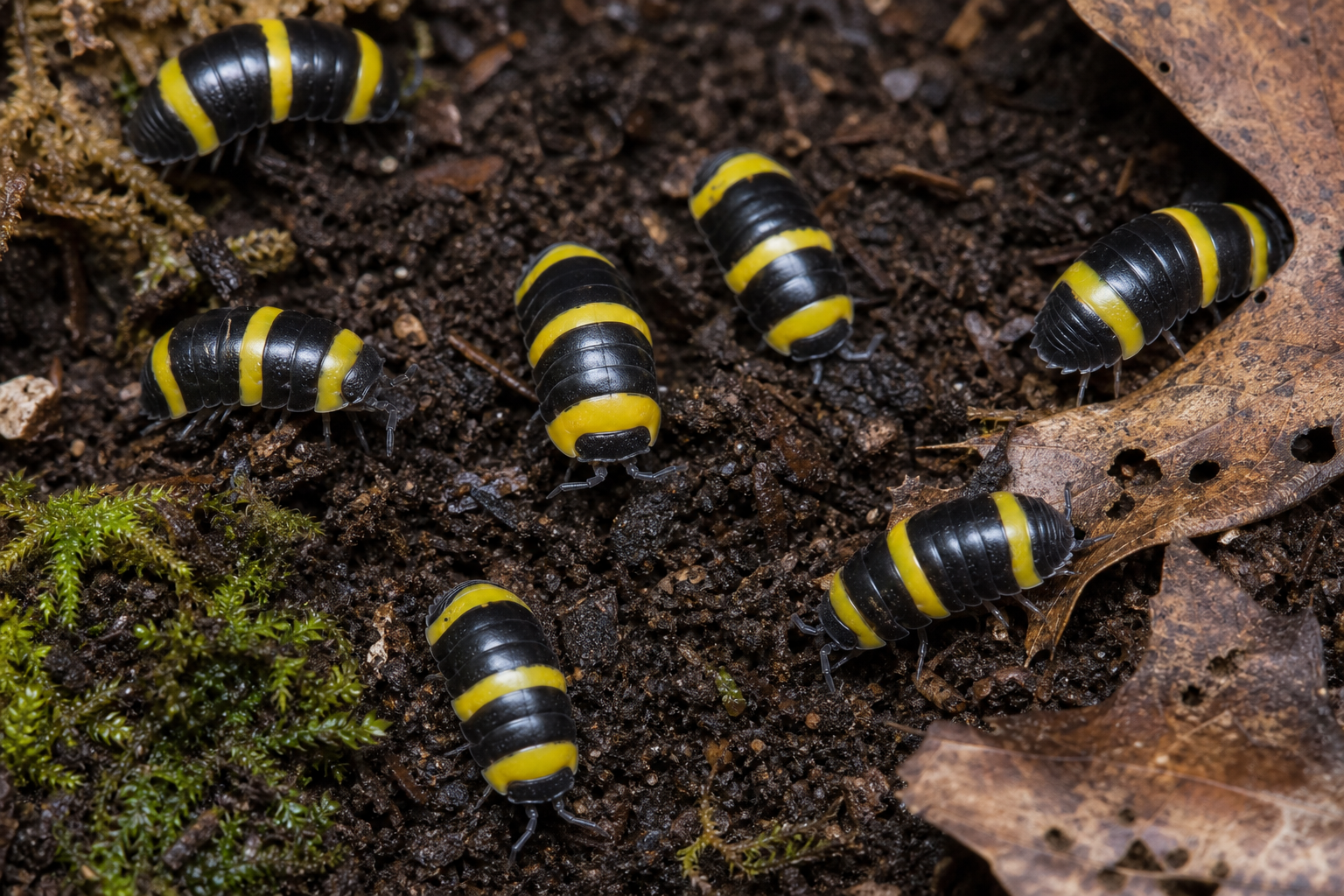
About Bumblebee Isopods
Black-and-yellow banding makes Bumblebees easy to spot. They are one of the more popular Cubaris morphs and are straightforward to keep once ventilation and calcium are sorted.
Cubaris sp. "Bumblebee" is a Cubaris from Southeast Asia. Like the rest of the genus, they want humid air that still moves, plenty of leaf litter, and calcium on tap. They breed slower than Porcellio, but the colour and behaviour are worth the wait if you are patient.
Morph-specific notes
Bold yellow bands develop as juveniles grow. Young ones can look mostly dark at first.
Housing & enclosure setup
Cubaris need good airflow. Stale air is the most common reason a colony crashes. A ventilated 6 US quart (~5.7 L) tub with holes along the sides and lid is what most keepers start with. Glass works for display too, as long as air can move through.
Give them 5–8 cm (2–3 in) of substrate. Cork bark, leaf litter, and limestone pieces help them hide and pick their own micro-climate. They are shy; poking the tub every day slows breeding.
Substrate & environment
Mix coconut coir or peat with aged hardwood, crushed limestone, and a thick cap of oak or magnolia leaves. Limestone (or crushed coral) matters here. Cubaris use more calcium than most temperate isopods.
Keep one side of the tub moist. The other can dry out a little, but do not let the whole thing go bone dry.
Temperature & humidity
- Temperature: 22–26°C (72–80°F). Try not to let them sit below 18°C or above 28°C for long.
- Humidity: 70–80% with airflow. Wet substrate plus no ventilation leads to mould and suffocation.
- Mist the moist side 2–3× per week, or whenever the gradient starts to fade.
Diet & nutrition
Staple: Oak and magnolia leaf litter, plus decaying hardwood.
Supplements (1–2× weekly):
- Vegetables: squash, carrot, cucumber (pull leftovers within 24–48 hours)
- Protein: fish flakes, dried shrimp, isopod diet mix (small amounts)
- Calcium: limestone, cuttlebone, or crushed coral. Leave a piece in at all times.
Go easy on protein. Extra food rots fast in humid tubs.
Breeding & colony management
Cubaris breed slowly compared to Porcellio. Broods are often small (5–15 mancae). Females carry young in a marsupium; babies hatch out looking like tiny adults.
- Try not to rehouse constantly. Wait until you see juveniles moving around regularly.
- Give a new culture 6–12 months before you harvest heavily.
- Do not pack the tub too full. Overcrowding stresses adults and can lead to cannibalism.
Common issues & troubleshooting
Colony crash / mass die-off
- Usually stale air or foul, anaerobic substrate. Open up ventilation, replace bad substrate, and move survivors to a fresh setup right away.
Mould outbreaks
- Cut back on protein, add springtails, improve airflow, and remove mouldy food.
Failed moults / pale, lethargic isopods
- Often a calcium problem. Add limestone and cuttlebone; check that the substrate is not too acidic.
No breeding after months
- They may still be settling in, or the tub is too dry or cold. Check humidity and temperature, and leave them alone for a while.
Mites
- Usually grain mites from overfeeding. Feed less, dry the tub out slightly, and add springtails. Split off heavily infested cultures if needed.